
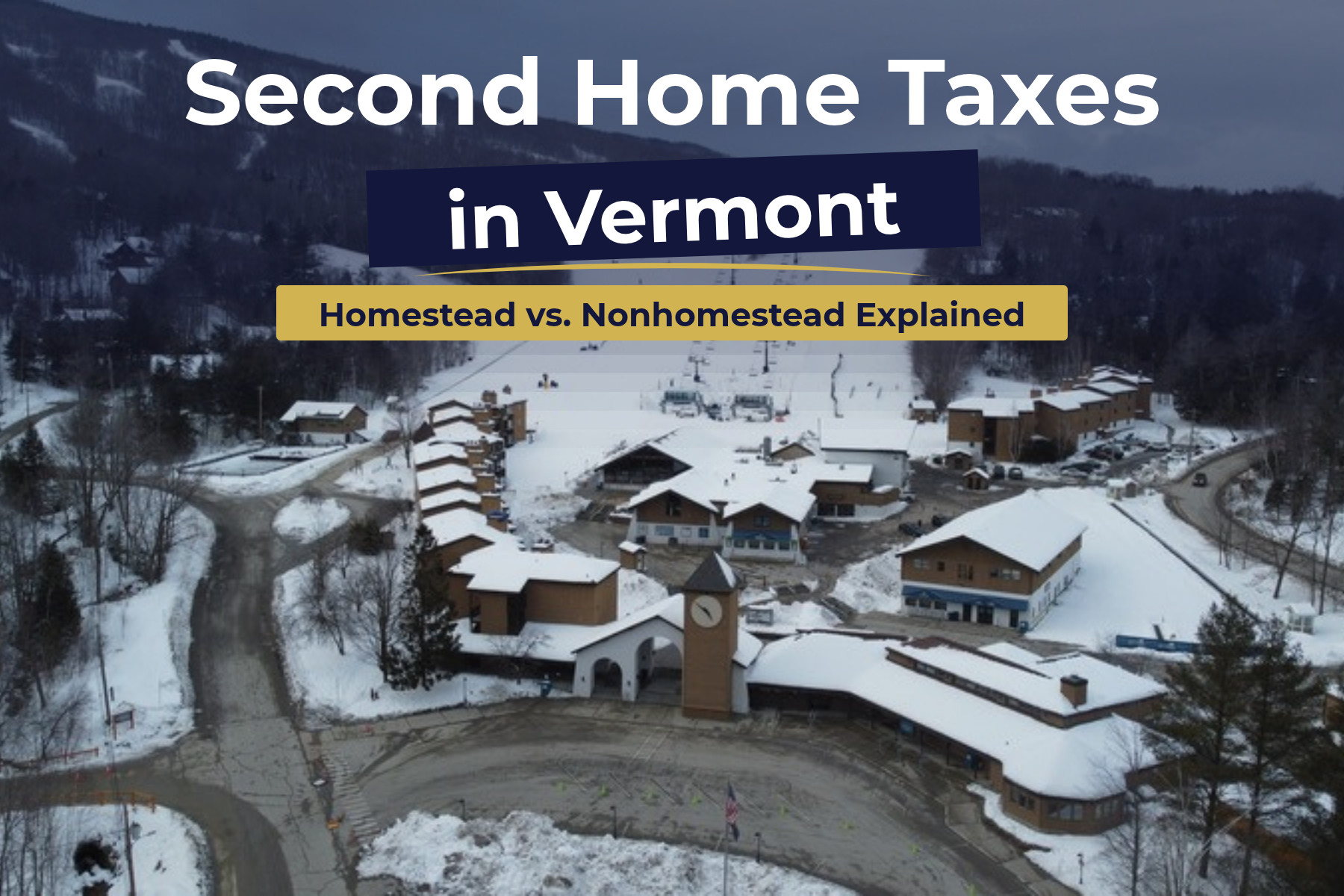
Do Second Homes Pay Higher Property Taxes in Vermont?
By Jacob Barnes, REALTOR® with eXp Realty | Updated November 2026
If you're looking at a ski condo in Ludlow, a chalet near Killington, or a camp on a back road in central Vermont, you've probably wondered: "Am I going to get hammered on taxes because it's not my main home?" It's a great question, and the straight answer is that it depends on the town, the year, and how you use the property.
Vermont's system is a little different from most states, so let's walk through how it actually works, what second-home owners pay right now, and what the Legislature is changing. I'll keep it practical so you can budget with confidence!
How Are Property Taxes Calculated in Vermont?
Your Vermont property tax bill has two separate parts: an education tax and a municipal tax. The education tax funds schools statewide and is where homestead and nonhomestead rates differ. The municipal tax pays for roads, town services, and local government, and it is levied on the town's grand list. The Vermont Department of Taxes notes that education and municipal taxes appear in separate columns on your bill.
Each tax is a rate per $100 of your property's assessed (listed) value. So if your town lists your home at $500,000, every $1.00 of tax rate equals $5,000 a year.
What is the Common Level of Appraisal (CLA)?
The CLA is how the state keeps towns paying their fair share when their grand lists are not at 100% of market value. The Department of Taxes calculates it each year through an equalization study. The CLA doesn't change your assessed value; it adjusts your town's education tax rate. For example, the Department explains that a $1.50 rate in a town with a 90% CLA becomes $1.50 divided by 0.90, or about $1.67.
Bottom line: always check the specific town's current rates, not just the statewide number.
What Is the Difference Between Homestead and Nonhomestead Property?
A homestead is your primary home in Vermont. Nonhomestead is everything else. On the 2026 Homestead Declaration (Form HS-122), a Vermont homestead is defined as "the principal dwelling and parcel of land surrounding the dwelling, owned and occupied by a resident individual as the individual's domicile on April 1, 2026."
The Department's instructions describe nonhomestead property as "property used for commercial purposes or property not used as the principal (primary) residence, such as a second home, camp, or summer cottage." A single property can be partly both, for example when part of the home is rented or used for a business.
| Homestead (primary home) | Nonhomestead (second home, camp) | |
|---|---|---|
| Who qualifies | Vermont resident who owns and occupies the home as their domicile on April 1 | Everyone else, including second homes, camps, and non-resident owners |
| Education tax rate | Set by your school district's per-pupil spending, then adjusted by the CLA | One statewide rate ($1.643 per $100 for FY2027), adjusted by the CLA |
| Municipal tax | Same town rate | Same town rate |
| Income-based Property Tax Credit | Eligible if household income qualifies (up to $8,000 on the 2026 form) | Not eligible |
| Paperwork | File a Homestead Declaration every year | No homestead filing |
What Is the Nonhomestead Tax Rate in Vermont Right Now?
For fiscal year 2027 (the 2026 to 2027 tax year), the statewide nonhomestead education tax rate is $1.643 per $100 of equalized education property value. That number comes from Act 169 of 2026, the annual "yield bill" the Governor signed on June 18, 2026. Your town's actual nonhomestead rate is that statewide figure adjusted by its CLA.
| Fiscal year 2027 figure (Act 169) | Amount |
|---|---|
| Nonhomestead education tax rate | $1.643 per $100 of equalized value |
| Property dollar equivalent yield (used to set homestead rates) | $9,401 |
| Income dollar equivalent yield (used for income-based homestead taxes) | $12,960 |
Here's a simple, hypothetical example. On a second home listed at $500,000 in a town with a 100% CLA, the education tax would be $500,000 divided by 100, times $1.643, or $8,215 for the year, plus the town's municipal tax. In a town with a 90% CLA, that $1.643 rate would become about $1.826 before the municipal rate is added.
Is the Homestead Rate Always Lower Than the Second Home Rate?
No, and this surprises a lot of people! The nonhomestead base rate is the same in every town, but the homestead rate depends on how much each school district spends per pupil. The Department of Taxes explains that beyond a certain level of per-pupil spending, the homestead rate will be higher than the nonhomestead rate.
That's exactly what happened in some places this year. The Chester Telegraph reported in July 2026 that in Chester and some neighboring towns, the FY2027 homestead rate came in higher than the nonhomestead rate, largely because of how the CLA and other statewide adjustments were applied. So a ski home in one town might carry a lower education rate than a full-time home in the next town over.
Where full-time residents usually come out ahead is the income-based credit. The Department of Taxes says about two-thirds of resident homeowners receive an income-based property tax credit each year. On the 2026 Form HS-122, the credit is available for household income up to $115,400, and the maximum credit is $8,000. Second-home owners and non-residents don't get that credit, so they generally pay the full bill.
Is Vermont Adding a Separate Second Home Tax?
Possibly, but not yet. Act 73 of 2025, Vermont's big education reform law, kept the homestead class and split nonhomestead property into two new classes. According to the Department of Taxes implementation report, "nonhomestead residential" is a new class "for residential property that is not being used as someone's long-term residence," which is where most second homes would land. "Nonhomestead nonresidential" would cover apartment buildings, business property, and open land.
- No second-home rate has been set. Act 73 created the class but did not set a rate for it.
- It's contingent. The Department's report says the new class only takes effect if the Legislature completes several steps, including new school district boundaries and approving the tax rate multipliers for each class.
- New paperwork may come with it. The report notes second-home and short-term rental owners don't file any attestation today, and the new system "would represent a new obligation for them."
- The timeline keeps moving. Compass Vermont reports that Act 170 of 2026 pushed parts of the education reform timeline further out. Until a new class takes effect, second homes keep paying the nonhomestead rate.
My advice: budget for today's rules with some cushion. I'll update this post as the Legislature acts.
What If I'm Moving to Vermont Full Time?
Then you'll want to claim your homestead! Homestead status depends on owning and occupying the home as your domicile on April 1, and the Homestead Declaration must be filed every year. On the 2026 form, the due date was April 15, 2026, and you could file as late as October 15, 2026, though the town may assess a penalty.
Don't skip it. The Department's instructions say towns can charge a late-filing penalty of up to 3% or up to 8%, depending on which rate is higher. Declarations filed after October 15 are classified as nonhomestead, and the owner is charged the higher of the two rates plus a penalty and interest.
If you're relocating, timing your purchase around April 1 is worth a conversation with your attorney and the town lister. For the full purchase process, see my step-by-step guide to buying a home in Vermont, and if you're still choosing a town, my guide to the best places to live in Vermont is a great starting point.
Does Renting Out My Vermont Home Change Its Tax Status?
It can. The 2026 Form HS-122 says that if your homestead is leased to a tenant on April 1, you may still claim it as a homestead as long as it is not leased for more than 182 days in the calendar year. The Department's instructions also say all rental use must be reported, and the rented portion of a property can be classified as nonhomestead.
If you're buying a ski property you plan to rent part of the year, talk with your accountant before you close. And if you ever sell, Vermont has its own seller tax rules too; my guide to selling a home in Vermont covers them.
Sources: Act 169 of 2026 (H.949), FY2027 yields and nonhomestead rate; Vermont Department of Taxes, Education Tax Rate FAQs; 2026 Form HS-122 Homestead Declaration; Vermont Department of Taxes, Form HS-122 Instructions; Department of Taxes, Act 73 Property Tax Classifications Implementation Report (Dec. 2025); The Chester Telegraph, July 15, 2026; Compass Vermont, Aug. 6, 2026; VTDigger, July 1, 2025.
Frequently Asked Questions About Vermont Second Home Property Taxes
Do second homes pay higher property taxes in Vermont?
Not always. Second homes pay the statewide nonhomestead education rate ($1.643 per $100 of equalized value for fiscal year 2027, adjusted by the town's CLA), while primary homes pay a homestead rate that varies by school district. In some towns the homestead rate is actually higher. The bigger difference is that second-home owners can't claim the income-based Property Tax Credit.
What is the nonhomestead property tax rate in Vermont for 2026-2027?
Act 169 of 2026 set the statewide nonhomestead education tax rate at $1.643 per $100 of equalized education property value for fiscal year 2027. Each town's actual rate is adjusted by its Common Level of Appraisal, and the town's municipal tax rate is added on top.
Can I claim a Vermont homestead if I only live there part of the year?
Only if Vermont is your domicile. The 2026 Form HS-122 defines a homestead as the principal dwelling owned and occupied by a Vermont resident as their domicile on April 1. A vacation home you use part of the year while living in another state is nonhomestead property.
When is the Vermont Homestead Declaration due?
It's due April 15 each year, the same day as Vermont income tax returns. On the 2026 form, you could file as late as October 15, but the town may assess a penalty. Declarations filed after October 15 are treated as nonhomestead.
Is Vermont creating a separate tax rate for second homes?
Act 73 of 2025 created a new "nonhomestead residential" class aimed at homes that aren't someone's long-term residence. No rate has been set, and the class only takes effect if the Legislature completes several more steps. Until then, second homes pay the nonhomestead rate.
Can non-residents get the Vermont Property Tax Credit?
No. The income-based Property Tax Credit is for Vermont residents who file a Homestead Declaration on their primary home. On the 2026 form, it was available for household income up to $115,400, with a maximum credit of $8,000.
Does renting out my Vermont home affect my homestead status?
It can. According to the 2026 Form HS-122, a homestead leased to a tenant on April 1 can still be claimed if it is not leased for more than 182 days that year. Rental use must be reported, and a rented portion of the property can be taxed as nonhomestead.
Thinking About a Vermont Second Home?
I'll help you understand the real carrying costs, including current tax rates in the towns you're considering, before you fall in love with a place. Browse Vermont towns on my communities page, then reach out. Call or text Jacob Barnes at 802-454-3632, or schedule a free consultation.
Tax rates and rules change every year. This article is for general information only and is not legal, tax, or financial advice. Jacob Barnes is a licensed real estate agent with eXp Realty.


Ready To Take The Next Step?
Schedule a no-obligation consultation with Jacob today and take the important first step toward achieving your real estate goals.
Schedule a Meeting