
Buying a Vermont Home With a Septic System or Well: What to Check
By Jacob Barnes, REALTOR® with eXp Realty | Updated November 2026
Once you get outside Vermont's villages and downtowns, a private well and a septic system are the norm. If you're moving from a place with town water and sewer, that's a whole new set of questions, and the answers can affect your price, your inspection timeline, and what you can do with the home later.
Here's what Vermont law requires, what it doesn't, and what to check before you close. This guide is for buyers of homes with an on-site septic system, a private well or spring, or both.
Does Vermont Require a Septic Inspection When You Buy a Home?
No. Vermont has no point-of-sale septic inspection requirement, and a well water test isn't required at sale either. Your protection comes from your purchase contract: an inspection contingency that lets you have the septic system and water checked before you're fully committed.
Permit problems can still surface during a sale. Violations of a wastewater permit are sometimes discovered during the title search, and the state's own guidance warns they can delay a sale or closing (Vermont DEC).
What Does 2007 Mean for Septic Permits in Vermont?
On July 1, 2007, Vermont took over permitting for all new wastewater systems and potable water supplies statewide, including single-family homes. Before that, many towns issued their own septic and well permits, and a single-family home on an older lot often didn't need a state permit at all.
Under 10 V.S.A. § 1974, buildings and their water and wastewater systems substantially completed before January 1, 2007, and lots that existed before that date, are exempt from needing a new state permit. This is often called the "clean slate" exemption. It holds only as long as nothing that requires a permit has been done since January 1, 2007, and the owner keeps following the conditions of any older permit.
So an older home with no permit on file isn't automatically a red flag. But if a bedroom was added or a failed septic system was replaced after 2007, there should be a state permit for that work, and it's worth asking the seller what's been done to the home and when.
What Triggers a New Septic or Well Permit in Vermont?
A state wastewater and potable water supply permit is required in these common situations:
- Subdividing land
- Building a new home or other building that needs a wastewater system
- Repairing or replacing a failed wastewater system or water supply
- Modifying a building or changing its use in a way that increases water or wastewater design flows, such as adding a bedroom
That last one matters for buyers. A Vermont wastewater permit approves a specific use and occupancy of the building. If a listing advertises four bedrooms and the permit covers three, ask about it before you're under contract.
Permits require a qualified licensed designer to design the water or wastewater system (Vermont DEC). If you're planning an addition, a guest suite, or a bigger family room after you buy, talk with a licensed designer early so you know what the existing system and lot can support.
How Do You Find the Septic Permit for a Vermont Home?
Start with the state's online Wastewater Regional Office Permit Search. You can search by permit number, town, landowner or applicant name, and street, and the database covers permits going back to September 18, 1969.
A few tips that make the search easier:
- Search past owners by last name only. Permits are filed under whoever applied, which is often a previous owner.
- Use the SPAN number. It's on the property tax bill and helps narrow the search.
- Check with the town. Many towns issued their own permits before July 1, 2007, and the planning and zoning office or town clerk may have them on file. Colchester and Charlotte still issue permits under the state rules.
- Call the DEC Regional Office if nothing turns up. Very old and unnumbered permits won't show up online but may still exist in the state's town files or on microfilm.
Your closing attorney will also look at water and wastewater compliance as part of the title search. I recommend Peet Law Group for Vermont closings, and their article on why Vermont's water and wastewater permits matter in your home purchase is a good read before you make an offer.
What Counts as a Failed Septic System or Well in Vermont?
A wastewater system is considered failed when sewage is surfacing on the ground, backing up into the building, or discharging into the waters of the state. On paper, a water supply is considered failed when it doesn't meet drinking water standards for total coliform, nitrate, nitrite, arsenic, or uranium (Vermont DEC).
"Failed" sounds scary, but a failed water test usually doesn't mean the well itself is bad. In most cases the fix is water treatment, like a filtration or UV system, and it's often a straightforward fix. When bacteria show up, disinfecting the well with chlorine bleach (called shock chlorination) can sometimes clear it up. The Vermont Department of Health publishes step-by-step well disinfection instructions and recommends retesting a few days after the chlorine smell is gone. If bacteria keep coming back, a permanent treatment system is the usual answer.
Repairing or replacing a failed septic system requires a state permit. For homes covered by the pre-2007 exemption, Vermont law allows the state to issue that replacement permit with a variance from the rules when a system has failed.
How Long Does a Septic System Last, and What Does Replacement Cost?
A well-maintained septic system can last for decades, but the leach field doesn't last forever. The EPA recommends planning for an upgrade once a system is 25 to 30 years old, and systems with a pump usually need the pump and controls replaced every 10 to 20 years (EPA). Replacing a failed system in Vermont typically runs somewhere around $15,000 to $50,000, with mound and advanced treatment systems on tough sites at the high end. Soil, slope, and access drive the price, so if a system is older or showing problems, get an estimate from a licensed designer before you negotiate.
What Should a Septic Inspection Cover?
In Vermont, a septic inspection is usually done by a local septic company, not an engineer. They'll typically do a visual inspection or scope the system with a camera, looking at the tank, the baffles, the lines, and the leach field, and checking how the system is performing. The tank may need to be pumped before it can be inspected, so plan for that in your timeline and ask the seller for any pumping records. Skip the dye test, too. The Vermont DEC homeowner guide advises against dye testing the system.
If the home has an innovative or alternative system (anything beyond a conventional tank and leach field), ask for its maintenance contract and inspection reports. These systems often carry ongoing permit conditions like yearly inspections and reporting, and since January 1, 2020, owners have been required to use vendor-approved service providers to oversee those inspections.
| What to check | What to ask for | Why it matters |
|---|---|---|
| State or town permit | Permit number, approved plans, and the use and occupancy it covers | Confirms the system was approved for the home as it exists today |
| Bedroom count | Compare the permit to the listing and floor plan | An unpermitted bedroom can mean added cost or limits later |
| Septic tank and leach field | Inspection by a local septic company (visual or camera scope, pumping first if needed), plus pumping records | Shows how the system is performing and how it has been cared for |
| Innovative or alternative system | Maintenance contract and yearly inspection reports | These systems often carry ongoing inspection and reporting conditions |
| Private well or spring | Well type (drilled, dug, or spring), age, depth, any history of running dry, plus a water test | Water quality and supply vary from one property to the next |
| Water pressure and flow | Run several fixtures at once, and consider a flow test | Separates a fixable pump or tank issue from a low-yield well |
| Shared well or spring | Recorded agreement or easement covering use, access, and shared costs | Without one, repairs and water rights can turn into disputes |
| Neighboring wells and septic systems | Locations on the survey or permit plans, plus any recorded septic or well easements | Isolation zones can cross property lines and limit where a replacement system can go |
| Loan distance rules | Ask your lender how far the well must be from the septic tank and leach field for your loan type | Some loans, like FHA new construction, require 100 feet between the well and leach field |
| Seller's well water information | Department of Health water testing fact sheet within 72 hours of a signed contract | Required for homes not served by a public water system |
Should You Test the Well Water Before Buying a Vermont Home?
Yes. Vermont doesn't require a water test when a home sells, but it's one of the most important inspections you can order on a rural property. For homes not served by a public water system, 27 V.S.A. § 616 requires the seller to give the buyer Department of Health materials on the health effects of contaminated groundwater and the availability of state test kits within 72 hours of a signed contract.
What Does "Sellers Must Share Well Water Information" Actually Mean?
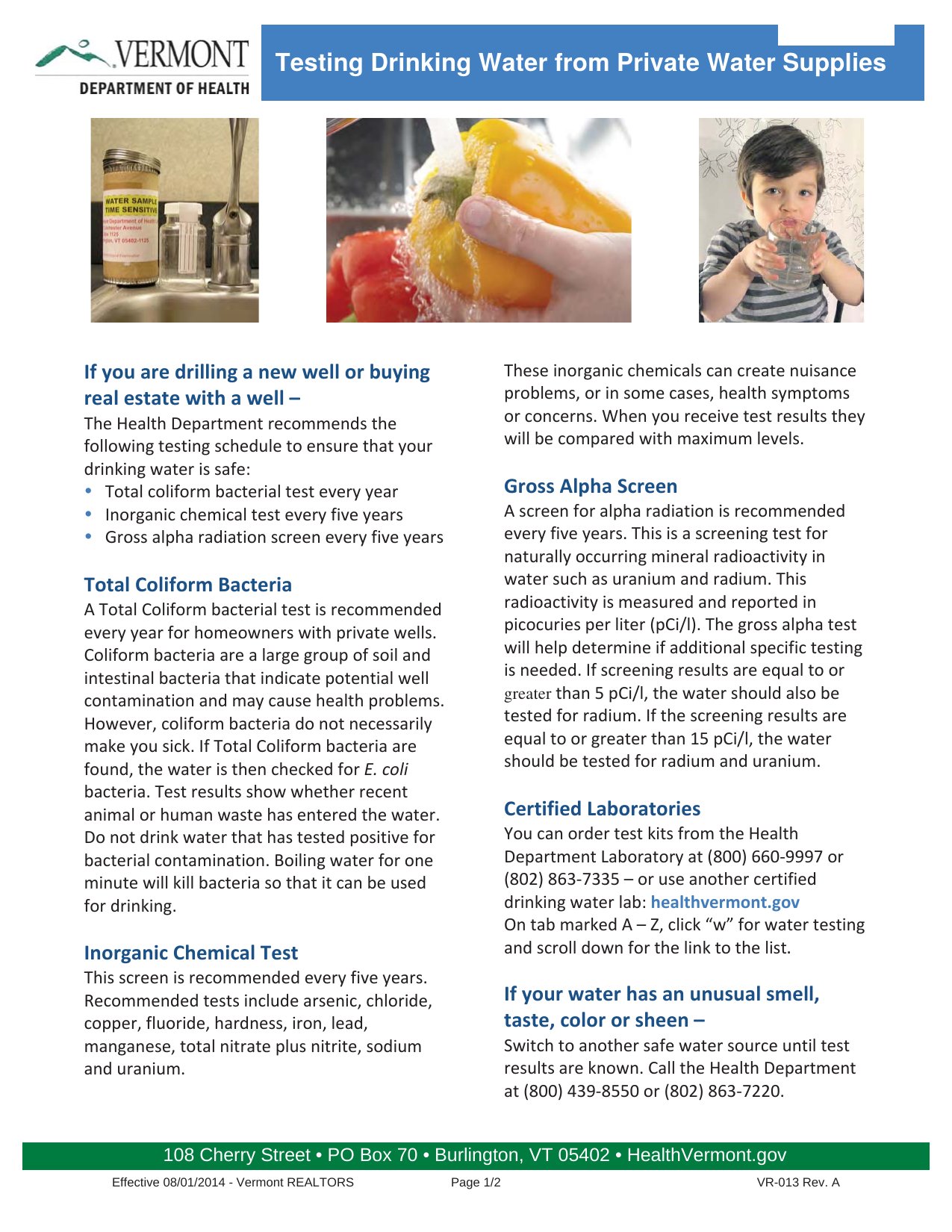
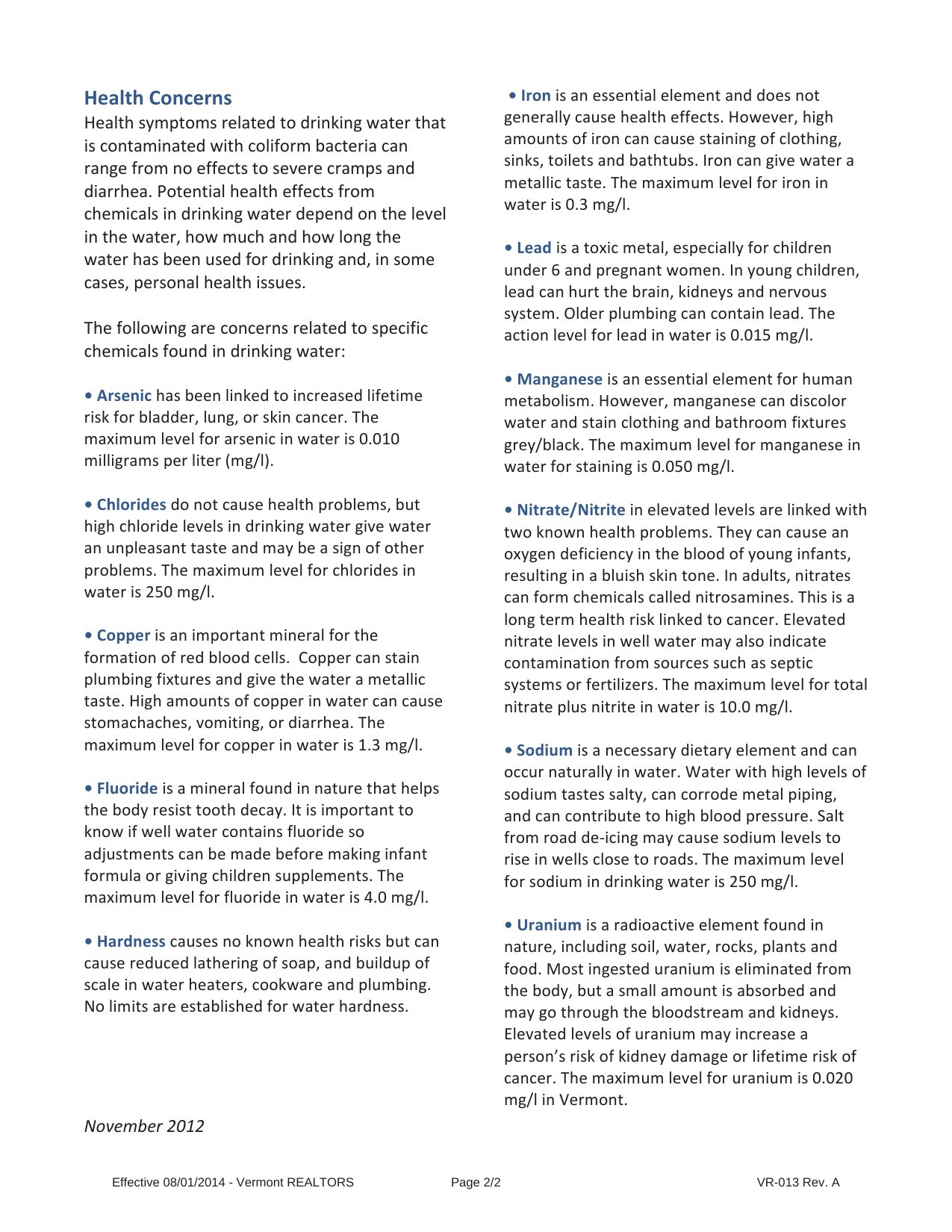
It's a fact sheet, not test results. The seller, usually through the listing agent, gives you the Vermont Department of Health's two-page sheet "Testing Drinking Water from Private Water Supplies," typically as a Vermont REALTORS form (VR-013). It covers:
- The Health Department's recommended testing schedule: bacteria every year, and inorganic chemicals and gross alpha radiation every five years
- What each test looks for, including coliform bacteria and E. coli, arsenic, lead, manganese, nitrate, uranium, and radioactivity
- Health concerns and the maximum levels for common contaminants
- Where to get a test kit and what to do if your water has an unusual smell, taste, color, or sheen
The law doesn't require the seller to test the well or hand over past results. It's still worth asking if they have any older water tests or treatment records.
How Do Buyers Usually Test the Water?
Most buyers don't order the test from the state themselves. Your home inspector can collect the water sample and send it to a certified lab. Options range from about $65 for a basic bacteria test to several hundred dollars for a much more detailed panel. It's typically done within the 14-day inspection period, so schedule it with your home inspection.
Check the water pressure and flow, too. Turn on a couple of faucets at once and run the shower, and ask your inspector or a well company about a flow test, which measures how many gallons per minute the system delivers over time. Weak pressure is often a fixable pump, pressure tank, or filter issue, but low flow from the well itself is a bigger deal, so it's worth knowing which one you're dealing with before you're past your inspection deadline.
Hard Water, Iron, and Sulfur Smell
Hardness, iron, manganese, and sulfur are some of the most common things Vermont well tests turn up. They usually aren't a health problem, but they're worth fixing. Hard water leaves scale in water heaters, cookware, and plumbing, and iron and manganese can stain sinks, tubs, and laundry and give water a metallic taste (Vermont Department of Health). A rotten egg smell usually comes from hydrogen sulfide, which can also corrode pipes and other metal parts of the plumbing (Vermont Department of Health).
The good news: these are usually solved with a water softener or a treatment system sized to your test results. Left alone, though, they can mean smelly water, stained fixtures, and shorter lives for your pipes, water heater, and appliances. If a home already has treatment equipment, ask how old it is and when it was last serviced.
Ask Whether the Well Has Ever Run Dry
This is one of the most important questions to ask, especially if the home has a dug well or a spring. They're much shallower than a drilled well, so they're more likely to run low in a dry summer and more easily contaminated by surface water. The Vermont Department of Health has found that about two out of three springs tested had coliform bacteria present (Vermont Department of Health).
If a drilled well runs low, there are often fixes short of starting over. A well driller may be able to lower the pump, hydrofracture the well (pumping water in at high pressure to open up fractures in the bedrock and improve flow), or drill the existing well deeper. If none of those work, the last resort is a new well. Drillers charge by the foot, so the cost depends on how deep they have to go, and replacing a well in northern New England often runs $15,000 to $25,000 or more (NH Department of Environmental Services; Vermont Public).
Once you own the home, keep testing on the Health Department's recommended schedule:
| Test | What it checks | How often |
|---|---|---|
| Bacteria | Total coliform and E. coli bacteria | Every year |
| Inorganic chemicals | Arsenic, lead, manganese, fluoride, nitrate, and more | Every five years |
| Gross alpha radiation | Naturally occurring radioactivity such as uranium and radium | Every five years |
New wells have their own rule. Under Vermont's Wastewater System and Potable Water Supply Rules, a landowner who drills a new well or deepens an existing one for a single-family home must test the water before using it, for a list that includes bacteria, arsenic, lead, manganese, nitrate, uranium, and gross alpha. If you're buying a newly built home with a new well, ask for those results.
A problem result doesn't have to end the deal. Treatment isn't required for a well serving only a single-family home, but it's recommended when results come back above health guidelines. Most issues can be handled with filtration or treatment, and the cost is a fair thing to raise in negotiations.
How Far Does a Well Need to Be From a Septic System?
Vermont's Wastewater System and Potable Water Supply Rules keep wells and septic systems apart so sewage can't reach your drinking water. The rules draw a presumptive isolation zone around every well and septic system, and its size depends on the size of the septic system and the well. It can sometimes be reduced with a hydrogeologic analysis, but generally not below 50 feet for a grouted well or 100 feet for a well that isn't grouted (Vermont DEC, 2026).
On smaller lots, the neighbors matter too. These isolation zones often cross property lines, and Vermont generally takes a first-in-time approach, so an existing well or septic system next door can limit where a new or replacement system can go on your lot, and yours can limit theirs. When someone applies for a permit and their isolation zone reaches onto a neighbor's land, they have to notify that neighbor before applying (Vermont DEC notification form). On a tight village or lakefront lot, it's smart to have a licensed designer look at where a replacement system could go before you buy.
Do Loans Have Their Own Well and Septic Distance Rules?
Yes, some do. FHA's standard requires a well to be at least 100 feet from a septic leach field and 50 feet from the septic tank (HUD). In July 2026, FHA issued a waiver for existing homes: if the well meets the state or local distance rules and the lender documents acceptable water test results, the home doesn't have to meet FHA's standard distances (FHA INFO 2026-17). New construction still has to meet FHA's standard distances.
USDA loans require well and septic distances to meet HUD or state and local requirements (USDA Rural Development), and individual lenders can add stricter rules of their own. If you're using FHA, VA, or USDA financing on a home with a well and septic system, tell your lender early and make sure the appraiser can locate the well, tank, and leach field on a survey or the permit plans.
Check for Septic and Well Easements
Sometimes a septic tank, leach field, well, or water line sits partly on a neighbor's land, or a neighbor's system sits on the lot you're buying. It's more common with older homes, shared systems, and subdivided lots. There should be a recorded easement covering it. Your closing attorney will look for easements in the title search, and a survey and the state permit plans help confirm where everything actually is. If a system crosses a property line and there's no easement, get it sorted out before closing.
Shared Wells and Springs
In rural Vermont, it's not unusual for two or more homes to share a well or a spring. Sometimes there's a written agreement covering who owns it, who can use it, and how maintenance, repairs, and electricity for the pump are split. Sometimes it's just a handshake between neighbors that goes back decades.
If the home you're buying shares a water source, ask for any recorded agreement or easement and have your attorney review it. Make sure it covers your right to use and access the water, how repair and replacement costs are shared, and what happens if the source runs low. Test the water pressure and flow when the other homes are using water too, since you'll be sharing the supply. If there's no written agreement, it's smart to get one recorded before closing, and check with your lender early, since some loan programs have their own requirements for shared wells.
How Do Septic and Well Issues Affect Your Offer?
Build the septic inspection and water test into your inspection period right alongside the home inspection. Some lab tests take a week or more to come back, and the septic tank may need to be pumped first, so schedule both early to get results before your contingency deadline.
If something comes up, you have options: ask the seller to repair or replace, negotiate a credit or price reduction, or walk away within your contingency period. My step-by-step guide to buying a home in Vermont shows how inspections fit into the whole process, and my guide to buying land in Vermont's Current Use program covers more to check on acreage.
Sources: Vermont DEC, The Importance of Understanding your Regional Office Permit; 10 V.S.A. § 1974, exemptions; Vermont DEC, How Do I Find My Septic System or Well Permit?; Vermont DEC, Wastewater Regional Office Permit Search; Vermont DEC, Wastewater System and Potable Water Supply Program; Vermont DEC, Homeowners Guide to Onsite Wastewater Systems (rev. February 2025); 27 V.S.A. § 616, groundwater source testing disclosure; Vermont Department of Health, Your Well and Your Family (February 2025); Vermont Department of Health, How to Test Your Drinking Water; Vermont DEC, Water Testing Requirements for New Groundwater Sources; Peet Law Group, Vermont's Water Supply and Wastewater Disposal Rules; Vermont Department of Health, Well Disinfection Instructions; Vermont Department of Health, Coliform Bacteria in Drinking Water; EPA, Why Maintain Your Septic System; NH Department of Environmental Services, A Comparison of Public Water Service to Private Water Wells; Vermont Public, Wells Are Running Dry (October 2025); Vermont DEC, Water and Wells presentation to the House Environment Committee (March 2026); Vermont DEC, Notification of Presumptive Isolation Zone (ANR Form 1); HUD, Individual Water Supply distance requirements; HUD, FHA INFO 2026-17, Waiver to Well Water Distance Requirements for Existing Construction; USDA Rural Development, Site Standards: Well and Septic; Vermont Department of Health, Hydrogen Sulfide in Drinking Water.
Frequently Asked Questions About Septic Systems and Wells in Vermont
Does Vermont require a septic inspection to sell a house?
No. Vermont has no statewide requirement to inspect a septic system when a home sells. Buyers protect themselves with an inspection contingency and an inspection by a local septic company, which may need to pump the tank first.
Do older Vermont homes need a septic permit?
Homes and their water and wastewater systems substantially completed before January 1, 2007 are generally exempt from needing a state permit. The exemption ends if work that requires a permit, such as adding a bedroom or replacing a failed system, is done on or after January 1, 2007.
How do I find the septic permit for a house in Vermont?
Use the Vermont DEC Wastewater Regional Office Permit Search online and search by permit number, town, landowner name, or street. If nothing turns up, check with the town planning and zoning office or town clerk, then contact the DEC Regional Office for the area.
Do you need a permit to add a bedroom in Vermont if you have a septic system?
Generally, yes. A Vermont wastewater permit approves a specific use and occupancy of the building, and changes that increase water or wastewater design flows, like adding a bedroom, require a state permit. The system design must come from a licensed designer.
Is well water testing required when buying a house in Vermont?
No, but the seller of a home not served by a public water system must give the buyer the Department of Health's water testing fact sheet within 72 hours of a signed contract. Most buyers have the water tested through their home inspector during the inspection period, with options from about $65 for bacteria to several hundred dollars for a detailed test.
How often should you test well water in Vermont?
The Vermont Department of Health recommends testing private wells for bacteria every year and for inorganic chemicals and gross alpha radiation every five years. Newly drilled or deepened wells serving a single-family home must be tested before the water is used.
Buying a Home in Vermont?
A well and septic system shouldn't scare you off a great property! They just take a little homework. If you need help buying in Vermont, I'd love to help you find the right home and get the right inspections lined up. My guide to living in rural Vermont is a great next read. Call or text Jacob Barnes at 802-454-3632, or schedule a free consultation.
This article is for general information only and is not legal, tax, or financial advice. Jacob Barnes is a licensed real estate agent with eXp Realty.


Ready To Take The Next Step?
Schedule a no-obligation consultation with Jacob today and take the important first step toward achieving your real estate goals.
Schedule a MeetingKatherine Bishop
Jacob’s courtesy and professionalism are unsurpassed! He really went the extra mile answering all my questions about real estate in VT. If/when I buy property there, he would be my go-to realtor.
View on GoogleRachel Jarrell
Jacob is a fantastic, skilled real estate agent who listened to our needs and worked with us to find a home in Vermont. We found him through his informative YouTube channel and couldn't be happier with his professionalism and knowledge of the area! He even referred us to a colleague to sell our home out of state so we could move forward buying property in Vermont. We highly recommend Jacob!!
View on GoogleJenna Clark
Jacob is an awesome realtor and I so appreciate his quick, kind, and thorough communication to his clients. Getting weekly email updates about the status of different things and our timeline was so helpful for our family as closing came near! Would definitely recommend him (and plan to) for anyone seeking help buying a home!
View on Google