
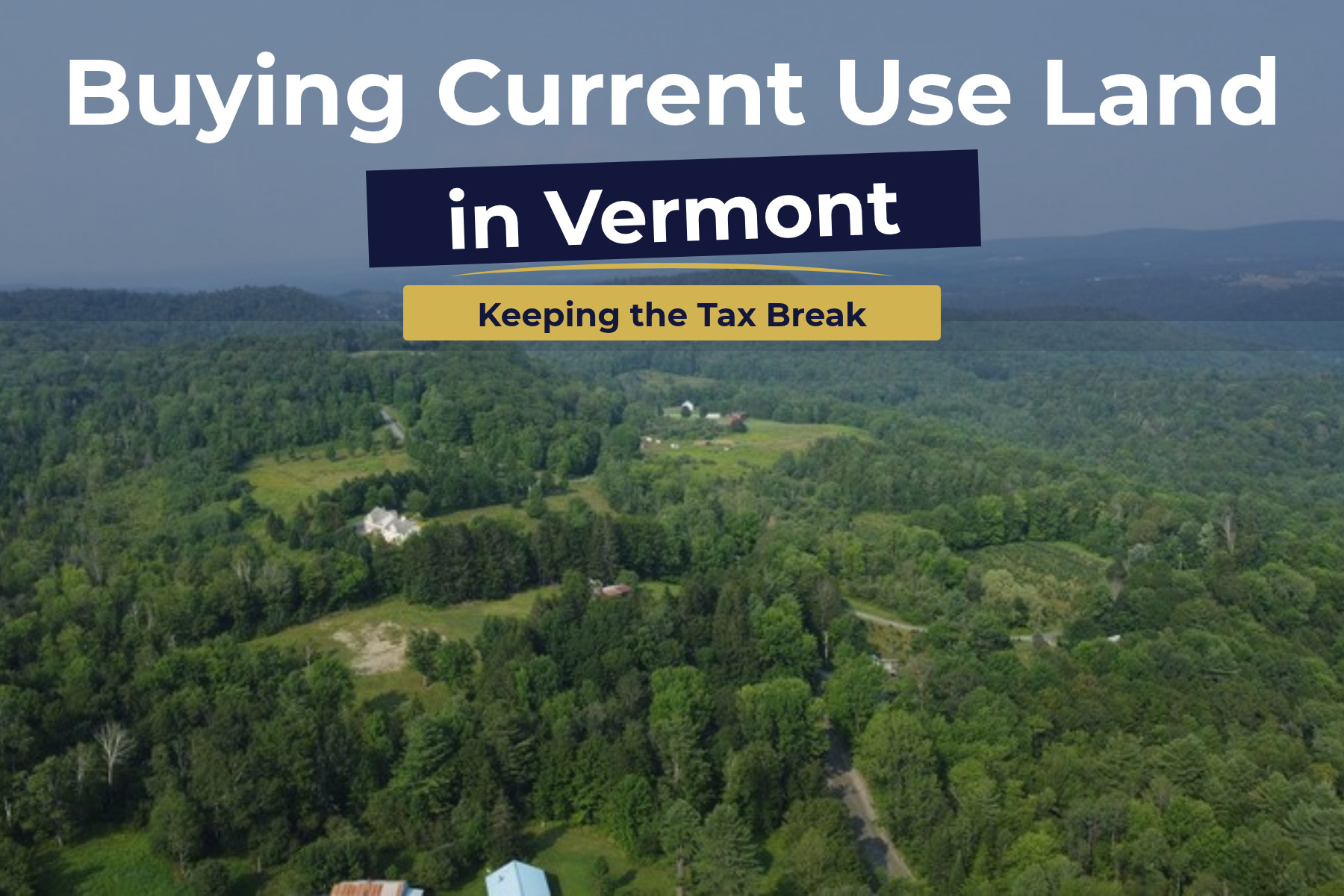
What Happens When You Buy Land in Vermont's Current Use Program?
By Jacob Barnes, REALTOR® with eXp Realty | Updated November 2026
If you're shopping for acreage in Vermont, you'll see "enrolled in Current Use" on a lot of listings. It's one of the best tax breaks a Vermont landowner can have, and it can also be the most misunderstood line in a land deal!
I grew up on a dairy farm in Addison, so working land is personal to me. Here's my plain-English guide to what Current Use is, what happens to it when you buy, and the questions I work through with every buyer before they make an offer on enrolled land.
What Is Vermont's Current Use Program?
Current Use, officially Use Value Appraisal, taxes qualifying farm and forest land on what it's worth as working land instead of what a developer would pay for it. Vermont created the program in 1978, and the Department of Taxes' Division of Property Valuation and Review runs it.
It's huge. About 2.57 million acres, roughly one-third of Vermont's total land, is enrolled across 19,692 parcels (Vermont Legislative Research Service, 2025). In 2024 the program saved enrolled owners about $76 million in education and municipal property taxes combined. Out-of-state owners are a big part of it too: 23% of enrolled parcels belong to owners whose primary ZIP code is outside Vermont.
In exchange, the owner keeps the land in active farm or forest use and accepts a lien that comes due as a tax if the land is ever developed.
How Many Acres Do You Need to Enroll in Current Use?
Most land needs at least 25 contiguous acres. The property types eligible for Current Use break down like this:
| Property type | Basic requirement | Ongoing obligation |
|---|---|---|
| Agricultural land | At least 25 contiguous acres in active farm use, or a smaller parcel earning at least $2,000 a year from farm crops, or land owned by or leased to a farmer | Annual agricultural certification by November 1 |
| Managed forest land | At least 25 contiguous acres managed under an approved forest management plan | Follow the plan, update it every 10 years, and file a Forest Management Activity Report by February 1 after any year with activity |
| Farm buildings | Actively used by a farmer as part of a farming operation, on enrolled land or an adjoining housesite | Exempt from all property taxes while they qualify |
| Conservation land | Owned by a qualifying nonprofit conservation organization and under active conservation management | Follow the conservation management plan |
New enrollments have a firm deadline: an application must be filed by September 1 to take effect for the following tax year (32 V.S.A. § 3756). If you're buying land that isn't enrolled yet and want to add it, plan around that date.
Does Current Use Transfer to a New Owner When Land Is Sold?
The lien and the obligation transfer automatically. The tax break does not. You keep the lower assessment only if you take a few steps right at closing.
Under 32 V.S.A. § 3756, a new owner continues enrollment by electing Current Use on the property transfer tax return, then applying and paying the application fees within 30 days after the town receives that return for recording. Miss it, and the parcel can be removed from the program.
The buyer's checklist at closing
- Elect continuation on the transfer tax return. Your closing attorney handles this form, so tell them early that you want to stay enrolled.
- File your own application. The Current Use application is Form CU-301, with Form CU-302 for any additional owners or trustees. A new application is required for every change of title, even a transfer into your own trust or LLC.
- Take over or replace the forest plan. For forest land, you either adopt the previous owner's forest management plan by signing a signature page or have a new plan written, then submit it with the plan maps and a revised Data Entry Form to the county forester.
- Calendar the ongoing deadlines. November 1 for agricultural certification, February 1 for forest activity reports, and the 10-year plan update.
Buying only part of an enrolled parcel? Then both you and the seller file new applications for each resulting parcel.
How Much Is the Land Use Change Tax in Vermont?
The land use change tax is 10% of the full fair market value of the land that changed, valued as if it had never been in Current Use (32 V.S.A. § 3757). It's due from the owner 30 days after the tax notice is mailed.
Here's an example with round numbers. If you clear and build on 5 enrolled acres worth $60,000 at full fair market value, the tax would be $6,000. The tax applies only to the portion that changed, not the whole property.
| Action on enrolled land | Triggers the land use change tax? |
|---|---|
| Building a house, road, or other structure | Yes, on the land that changed (withdraw a 2-acre housesite first for a dwelling) |
| Mining, excavation, or a landfill | Yes |
| Subdividing or selling off a parcel under 25 acres | Yes, with an exception for transfers to close family members who reenroll within 30 days |
| Cutting timber contrary to the forest management plan | Yes, and the land is removed from the program for five years |
| Withdrawing from the program and removing the lien | Yes, valued at the time of withdrawal |
| Withdrawing but leaving the lien in place | Not yet; the tax comes due later if the land is developed or the lien is removed |
| Selling the whole parcel intact | No; the lien simply transfers to the buyer |
Act 164 of 2026 tightened the timeline starting October 1, 2026: once the Department of Taxes notifies the town, local assessors have 30 days to set the fair market value of the changed land, and the owner has 30 days to appeal that value (Act 164 of 2026). The 10% rate itself didn't change.
Can You Build a House on Land Enrolled in Current Use?
Yes, but not on enrolled land. Land used for a dwelling can't be enrolled, so before you build you withdraw a 2-acre housesite from the program using a Request for Withdrawal (Form LV-314) with updated maps, and pay the land use change tax on that piece.
Several dwellings can share one 2-acre housesite. If the listing already has a house, check the Current Use map to confirm the house, driveway, septic, and yard all sit outside the enrolled acres.
What If You Don't Want to Keep the Land in Current Use?
You can leave the program by filing a Request for Withdrawal through the Department of Taxes' myVTax system. Your property taxes then go up to full fair market value, and the lien stays on the land until the land use change tax is paid.
You also have the option to pay the tax up front to clear the lien from your title. Whether that makes sense depends on your plans for the land, so run the numbers both ways before closing. If you'll be living on the property full time, my guide to Vermont second home property taxes explains how homestead and nonhomestead rates apply to the land and house that aren't enrolled.
What Should You Check Before Buying Current Use Land?
Get these answers before you sign a purchase contract, not after. This is the list I work through with my land buyers:
- The Current Use map. Ask for the enrollment map and see exactly which acres are enrolled and where the housesite is.
- The forest management plan. Read it. It tells you what harvests are scheduled, when the plan expires, and what the county forester expects.
- Your plans for the land. If you want to build a second home, add a barn, or carve off a lot for family, figure out the land use change tax before you write the offer.
- Who pays if a split triggers the tax. If the sale itself carves off a parcel under 25 acres, settle in the contract who pays the land use change tax.
- The tax bill with and without Current Use. Ask the town for the current assessment so you know what your taxes would be if you ever withdraw.
For the rest of the purchase process, from financing to closing, see my step-by-step guide to buying a home in Vermont. My guide to living in rural Vermont covers daily life on acreage, and my Orange County community page is a good start for land near my home base in Williamstown. A good real estate attorney is a must on any land deal, and I recommend Peet Law Group.
Sources: Vermont Department of Taxes, About Current Use; Vermont Department of Taxes, Current Use Property Types; Vermont Department of Taxes, Current Use Enrollee Information; Vermont Department of Taxes, Current Use FAQs; Vermont Department of Taxes, Land Use Change Tax; 32 V.S.A. § 3756, Enrollment and transfers; 32 V.S.A. § 3757, Land use change tax; Act 164 of 2026; Vermont Legislative Research Service, Vermont Current Use Program Profile and Impacts (December 2025).
Frequently Asked Questions About Buying Current Use Land in Vermont
Does Current Use transfer to a new owner in Vermont?
The Current Use lien transfers automatically because it runs with the land, but the lower tax assessment doesn't continue on its own. The new owner must elect continuation on the property transfer tax return and file a new Current Use application, with fees, within 30 days after the return is received by the town for recording.
How much is the land use change tax in Vermont?
Vermont's land use change tax is 10% of the full fair market value of the land that is developed or withdrawn, valued without regard to its Current Use assessment. It applies only to the portion that changed and is due 30 days after the tax notice is mailed.
How many acres do you need for Current Use in Vermont?
Agricultural land and managed forest land generally need at least 25 contiguous acres. Smaller agricultural parcels can qualify if they earn at least $2,000 a year from farm crops or are owned by or leased to a farmer.
Can I build a house on land enrolled in Current Use?
Not on enrolled land. Before building a dwelling, you withdraw a 2-acre housesite from the program with Form LV-314 and updated maps, and you pay the land use change tax on that land. Several dwellings can share one 2-acre housesite.
Does selling Current Use land trigger the land use change tax?
Selling an enrolled parcel intact doesn't trigger the tax; the lien just transfers to the buyer. A sale or subdivision that creates a parcel under 25 acres counts as development and does trigger it, except for certain transfers to close family members who reenroll within 30 days.
What happens if I buy Current Use land and don't reapply?
Without a timely new application, the land can be removed from the program and taxed at full fair market value. The lien stays on the land until the land use change tax is paid, so missing the deadline doesn't make the obligation go away.
Thinking About Buying Land in Vermont?
Whether it's a woodlot for a future home, a hillside farm, or a big parcel with room for your family to spread out, I'll help you understand the Current Use rules and the real costs before you buy. Call or text Jacob Barnes at 802-454-3632, or schedule a free consultation.
Tax rules and Current Use program requirements change. This article is for general information only and is not legal, tax, or financial advice. Jacob Barnes is a licensed real estate agent with eXp Realty.


Ready To Take The Next Step?
Schedule a no-obligation consultation with Jacob today and take the important first step toward achieving your real estate goals.
Schedule a Meeting